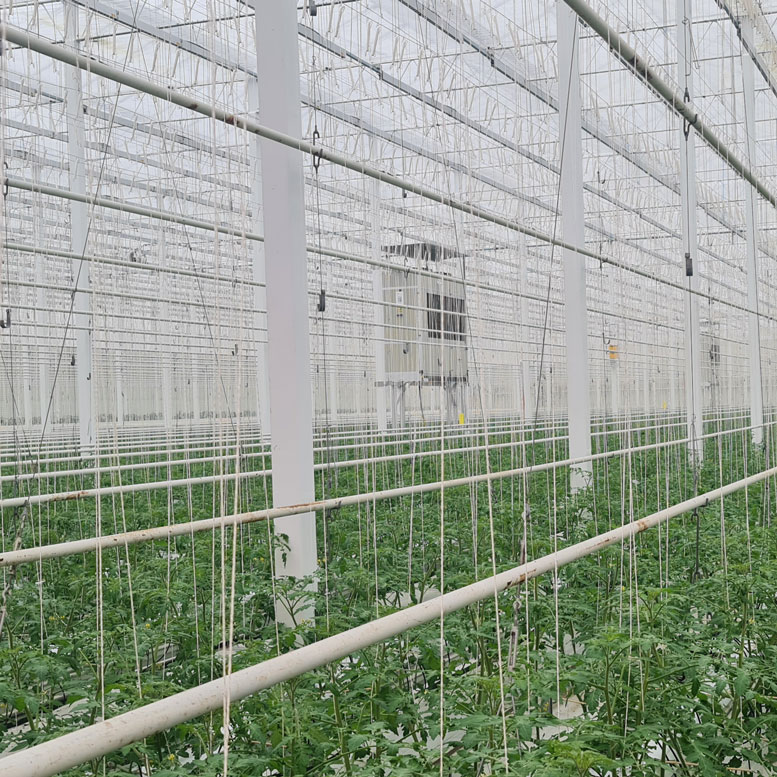
Hydroponic Greenhouses & Grow Rooms – How to Improve Hydroponic Gardening
Hydroponic farming is a popular technique growers around the world use to produce large, high-quality yields. By optimizing your hydroponic greenhouse or indoor cultivation, you can further improve production, leading to even larger yields in shorter periods.
This guide explains what hydroponic growing is, different types of hydroponic systems, and how to improve your hydroponic production. We will also present some of the pros and cons of growing using a hydroponic setup.
What Is Hydroponic Farming?
Growing hydroponically means growing plants without soil or a growing medium, such as coconut coir or coconut fiber. Rather, the plants grow in water that contains dissolved nutrients. The water therefore provides the necessary ingredients for plants to grow and develop.
Hydroponically grown plants tend to grow faster and larger than their traditional counterparts. This is due to the ability to control exactly what nutrient solution they receive. Hydroponic plants also enjoy greater optimization when it comes to their root conditions. This includes not only nutrients, but also the pH level, oxygen levels, and even temperature.
Types of Hydroponic Systems
Hydroponic growing relies on a specific set of principles. However, there are many different types of hydroponic growing systems. While these utilize the same principles, they use different techniques, each with its own pros and cons.
Some techniques, such as a wick system, drip system, or the Kratky method, are more suited to small-scale hydroponic gardening. We’ll be focusing on methods that have large-scale viability for indoor hydroponic farming and hydroponic greenhouses. These include deep water culture (DWC), nutrient film technique (NFT), and ebb and flow systems.
Deep Water Culture (DWC)
Deep water culture is the most basic type of hydroponic growing. In this technique, you place the plants on a growing tray, with the roots submerged in a water reservoir. The reservoir contains the necessary water and nutrients.
Another critical component for plant growth is oxygen, which is readily available in soil and other growing mediums. However, because the roots are always under water in deep water culture systems, you need to provide oxygen yourself. This requires an air pump and an air stone to distribute the air as small bubbles for the roots to absorb.
Though deep water culture is a relatively basic technique, it’s still viable in a commercial setup. Many hydroponic greenhouses stack growing trays vertically, to produce very large yields in a small area.
Ebb and Flow
Ebb and flow systems, sometimes called “flood and drain” are similar to DWC. However, instead of constantly submerging the roots in the nutrient solution, we periodically introduce the water, and drain it. This allows the plants to access both nutrients and oxygen.
So, unlike DWC, these systems do not require an air pump. They do, however, require a water pump, timer, and syphon.
In this type of system, you place the water in a separate water reservoir. The water pump, run on a timer, then transfers the nutrient-rich water to the grow tray at pre-determined times. Once the tray floods, the syphon drains the water back to the tank.
Nutrient Film Technique (NFT)
Nutrient film technique is one of the most popular methods of hydroponic farming. In this setup, you place the plants in net pots, with the roots placed in pipes that carry the water.
Similar to ebb and flow systems, you place the water in a separate tank. A water pump then constantly transports water to the top of the pipe formation. From there the water flows through the roots, back to the tank.
As the nutrient film usually doesn’t drown the roots, there’s sufficient oxygen for the plants. Additionally, as the water falls back into the tank, it introduces air bubbles. This enriches the water with oxygen, so there’s rarely a lack of oxygen in the system.
How to Optimize Hydroponic Greenhouse and Indoor Cultivation
Greenhouse hydroponic production is similar to traditional greenhouse horticulture. It requires climate control systems to optimize growing conditions, such as temperature, humidity, carbon dioxide, etc. to maximize production.
However, there are some additional factors to consider. The biggest difference, of course, is in optimizing the nutrient solution.
Adjusting the Nutrient Solution
There are 2 main factors to consider when it comes to the nutrient solution – nutrient concentrations and acidity. These require constant monitoring and manual adjusting.
Nutrients are measured in EC (electrical conductivity). This may not sound intuitive. But as nutrients increase the number of electrolytes in the water, EC provides a simple proxy to measure nutrient concentrations.
If EC is too low, you should adjust by adding liquid fertilizer. If it’s too high, you can adjust by simply adding more water to the system.
The second parameter to control is acidity (pH). This is a critical factor for hydroponics, as water is much less effective at regulating acidity than soil. Adjusting the pH is relatively simple. There are products you can use to either raise or lower acidity according to your needs.
Controlling Climate Conditions
Any closed environment agriculture facility requires climate control systems to be successful. Hydroponic farms are no different. In fact, they require tighter control and stricter protocols.
This is due to the fact that water provides less of a buffer than soil. Any change in temperature, for example, will have a quicker and more significant impact in a hydroponic setup. Water changes temperature faster than soil, leaving the roots exposed to fluctuations, which may harm your plants.
Two of the most important climate factors, for any greenhouse or grow room, are temperature and humidity. These have a significant impact on plants, and ultimately determine whether a grow is successful or not.
Temperature Control
Every plant has an ideal temperature range, in which it grows fastest, largest, and healthiest, regardless of growing technique.
So, hydroponic greenhouses and grow rooms require some sort of temperature controller, like any other facility. However, the type of temperature control depends on the environment, as well as the crop.
In most cases, controlled environment agriculture requires heating. You can do so by using heat pipes and a boiler, HVAC, etc. On the other hand, some facilities may require cooling. Some popular cooling techniques include wet pads and fans, chillers, or HVAC as well.
The importance of temperature control is greater when it comes to hydroponic farming. In traditional horticulture, the soil or growing medium provides a buffer between the plants’ roots and the environment. So temperature fluctuations have a slower impact.
In a hydroponic setting, the buffer is much smaller. Air temperature affects water much quicker than soil. So any drop or jump in temperatures can have a major impact on the plants.
Humidity Control
Like temperature, every plant has a preferred relative humidity, or VPD range. Outside of this range, plants don’t grow or produce fruit to their maximum potential. In many cases, low or high humidity may lead to diseases and molds, such as botrytis, causing the plants to die.
Hydroponic settings require the same amount of humidity control as any other growing facility. However, unlike temperature, in most cases humidity control requires reducing humidity, rather than increasing it. This is especially true in hydroponic setups that include vertical layers. Examples of which would include stacked DWC or ebb and flow trays, or most NFT setups.
This is due to the increased number of plants in an area, compared to traditional cultivation. More plants create more humidity, so you’ll need higher capacity humidity dehumidification in order to maintain ideal humidity levels.
Traditionally, greenhouse growers reduce humidity using a combination of heating and ventilation. While this method is useful in certain situations, it’s often ineffective and highly inefficient, leading to high energy costs.
The modern alternative for humidity control is active dehumidification. Dehumidifiers, such as DryGair, extract moisture from the air, reducing humidity without ventilation or excessive heating.
When it comes to hydroponics, the benefits of dehumidification are even more significant. First, the system is much more susceptible to temperature fluctuations. So the ability to keep the space closed and controlled is critical. Ventilation leads to rapid fluctuations in conditions, which can have a devastating effect on hydroponic farms.
Additionally, hydroponic farms require much more energy than their traditional counterparts. This is due to the additional machinery, as well as the increased temperature control. So, the ability to save energy by reducing ventilation can be very beneficial, saving an average of 50% on heating costs.
Hydroponic Farming – Pros and Cons
Hydroponic farms have their own unique set of requirements, risks, and benefits. So, what are the pros and cons of growing in a hydroponic setup? Should you grow using traditional soil and growing mediums, or opt for a hydroponic setup?
Pros of Hydroponic Farming
Improved Growth
Growing in a hydroponic system lets you optimize production to a much higher degree than traditional cultivation. You can provide exactly the right amount and concentrations of nutrients and provide optimal pH levels. The roots have an easier task of accessing these nutrients as well.
These lead to larger growth, at a faster rate. This is especially true for leafy greens, such as lettuce, or herbs such as basil. It’s true for a wide variety of vegetables as well. For many growers, this is the main reason behind choosing hydroponics.
Less Water Usage
One of the biggest benefits of hydroponics is in water consumption. Traditional horticulture is often wasteful with water, which is lost in different points throughout the growing process.
Hydroponic systems are much more efficient in terms of water usage. This is due to the fact that hydroponics being a closed systems, constantly reusing the same water. In fact, studies have found that hydroponic greenhouses require as much as 90% less water than traditional greenhouses.
Reduced Land Requirements
Hydroponic farms are more efficient in terms of space, through several factors. First, is the fact that crops can grow larger and faster, leading to higher yields per square foot. In a study conducted in Arizona lettuce greenhouses, it was found that a hydroponic setup provided 11-times more produce than a traditional greenhouse.
Second, is the ability to decouple cultivation from land. As hydroponics do not require soil or a growing medium, it’s much simpler to stack layers of crops. Of course, if you grow vertically, the amount of land necessary to achieve the same yields drops significantly.
Cons of Hydroponic Farming
Increased Energy Requirements
The main disadvantage of hydroponic farming is the increased need for control. This includes several factors, from the nutrient solution, through grow lights, to environmental controls. These all require energy, leading to higher costs.
Hydroponic setups are more susceptible to changing conditions. So, you’ll need higher capacity temperature and humidity controllers, increased monitoring, etc., which require more energy than traditional greenhouses.
Higher Initial and Operational Costs
Hydroponic greenhouses and grow rooms require tight control. So, besides energy, there are other additional costs.
The infrastructure needed for hydroponic growing is greater than that of traditional farming. While they both have a basic set of needs, hydroponic setups require some additional systems and equipment. These lead to higher initial costs, as well as additional operational costs to run and maintain everything with minimal downtime.