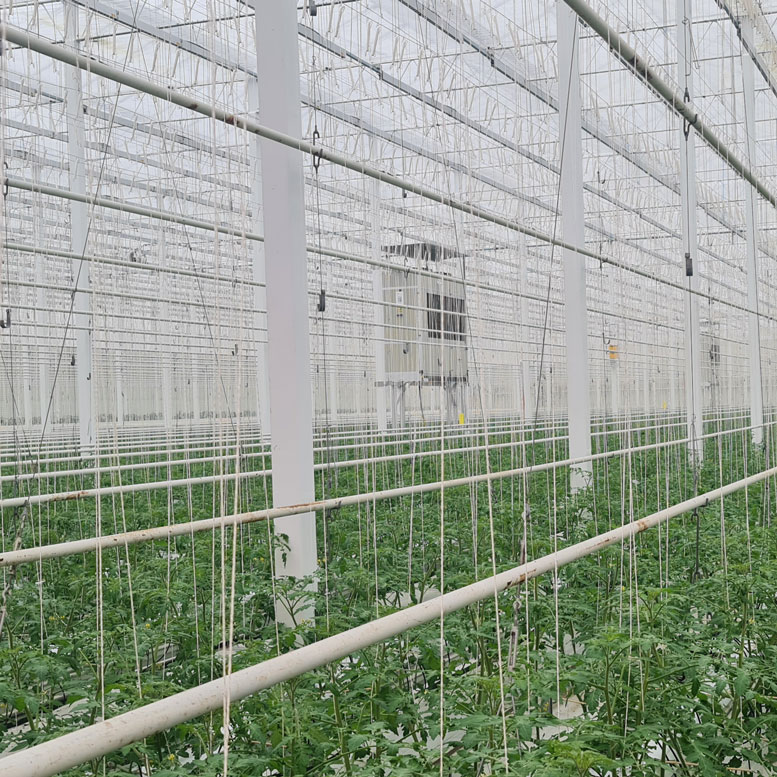
What are the Ideal Conditions for Greenhouse Tomatoes?
Tomatoes grow in relatively warm temperatures, making them the perfect greenhouse crop. Compared to outdoor tomato cultivation, growing in a controlled greenhouses increases yields and quality, reduces pests and diseases, and increases the growing season.
Tomatoes are one of the most popular vegetables (well, fruit…) in the world. So, it’s no surprise that they’re one of the most common crops in commercial horticulture. In fact, in 2020, over 185 million kgs were grown globally, on over 5 million hectares.
Tomato plants have a relatively short growing season, contrasted by a high demand year-round. Which is one of the main reasons growers around the world choose to grow tomatoes in a greenhouse.
The ability to control the temperature, humidity level, and lighting, allow growers to provide ideal growing conditions throughout the year. In most of the world, this wouldn’t be possible without a controlled environment.
Optimal Growing Conditions for Tomato Crops
Greenhouse cultivation has many benefits, but not without challenges. Cultivating tomatoes in a closed environment requires growers to create the optimal growing conditions, rather than rely on the weather.
This guide will help you provide the ideal tomato growing conditions. It’s important to remember, however, that specific conditions may differ between different tomato varieties.
Ideal Temperature for Tomato Greenhouse
Maintaining the right temperature is one of the most basic functions of greenhouse, regardless of how technological or advanced it is.
Providing optimal temperatures allows the plants to take in and break down nutrients as efficiently as possible. This leads to faster growth and fruit development. If conditions are too cold, or too warm, the plants will experience stress, which affects growth, as well as quality. In a temperature-controlled environment, there’s no reason to reach temperatures outside of the ideal range.
The ideal temperature for tomato cultivation is between 21-27°C (70-82°F). This range is also best during pollination. These temperatures are considered optimal for day time. During the night, tomato crops may enjoy lower temperatures, reaching 16-18°C (62-64°F).
Tomato plants grow best within this range, meaning they will exhibit the quickest development, largest yields, and highest fruit quality. However, depending on the variety, they may be able to grow well between 15-32°C (59-89°F).
The ideal temperature to germinate tomato seeds is between 18-29°C (65-85°F).
Ideal Temperatures for Tomato Cultivation:
- Day time – 21-27°C (70-82°F)
- Night time – 16-18°C (62-64°F)
- Seed germination – 18-29°C (65-85°F)
How to Maintain Optimal Temperatures for Tomatoes
Maintaining the right temperature for tomatoes differs from greenhouse to greenhouse. Some greenhouses are located in warmer climates than others. So, while most greenhouses require heating, some actually need cooling to reach the ideal range.
You can use ducts, heat pumps, boilers, chillers, HVAC, or other forms of air conditioning depending on your local climate.
Ideal Humidity for Tomato Greenhouse
Humidity, like temperature, has a major impact on tomato plants’ growth, development, yield and quality. In order to reach full potential, it’s important to maintain the right relative humidity level, or VPD range.
Outside of the ideal range, plants will struggle to perform physiological tasks, such as taking in nutrients or performing photosynthesis.
When humidity is too high, the tomato plants won’t be able to evaporate water through their stomata. This stops them from being able to take in more water and nutrients from the soil, inhibiting development.
Low humidity, on the other hand, will lead to water stress. In this case, the stomata close, in order to retain water. This has a similar effect, in which the plant shuts down important processes, slowing down growth and development.
It’s also important to note that many common diseases and mildews develop in high humidity, including botrytis and powdery mildew. So, maintaining ideal humidity levels also protects against diseases and reduces crop loss.
The optimal relative humidity level for tomatoes is between 60-85% RH. However, you can improve growth further by dialing in different relative humidity set points for night and day.
During the day, tomato plants may enjoy higher humidity levels of 80-85% RH. However, during the night, when the plants are less active, humidity levels of 65-75% are ideal.
The ideal relative humidity level for pollination is around 70%. In higher humidity, pollen may stick together, making it harder to disperse. In lower humidity, the plants’ stigma tends to dry out, reducing its ability to collect pollen.
In terms of VPD, the ideal range for tomatoes is generally between 0.5-0.8 kPa. However, higher VPD levels may be better during later developmental stages, such as flowering. In these stages optimal VPD levels can reach 1.2 kPa.
Ideal Relative Humidity & VPD for Tomato Cultivation:
- Day time – 60-85% RH
- Night time – 65-75% RH
- Pollination – 70% RH
- VPD – 0.5-1.2 kPa
How to Maintain Optimal Humidity for Tomatoes
It’s important to note that tomato crops, like all plants, release water vapor. So, in fact, they increase the humidity levels around them. In a closed environment, this will inevitably lead to high humidity.
Humidity is a complex issue. There are numerous factors that impact it. So it may be difficult to predict relative humidity levels at all times, throughout the growing space. Some factors that directly affect humidity include temperatures, grow lights, irrigation systems and airflow.
In most cases, greenhouse growers will need to reduce humidity, rather than increase it. There are two main methods to do so – through heating and ventilation, or through dehumidification.
Heating and venting is the traditional way greenhouse operators deal with humidity. It involves opening up windows and vents, in order to let the humid air out.
However, releasing air from inside and introducing outdoor air affects the conditions inside. In most cases, the air outside is cooler, meaning it lowers the temperature inside the greenhouse. That means you need more heating to compensate for the heat loss.
Heating and venting may be useful and even efficient when weather outside is fair. However, this method is highly inefficient in cold, humid, or rainy conditions, requiring a lot of additional heating just to maintain temperatures. Additionally, this method might not work in high humidity or rain, leaving growers with no solution.
So, in most climates, the only way to fully control humidity and ensure ideal conditions, is to use dedicated dehumidifiers. Dehumidification systems that are designed for greenhouse use provide the most comprehensive and energy efficient way to control humidity. In fact, using DryGair has been found to save an average of 50% on total energy consumption, compared to ventilation.
Use Air Circulation to Further Improve Conditions
Another important part of humidity control is air flow. While maintaining an overall ideal humidity level is crucial, conditions can vary throughout the greenhouse. Most importantly, humidity may be higher between densely placed plants, or inside the foliage.
These pockets of humid air are known as microclimates. They can be detrimental to tomato plants, slowing down growth and leading to disease outbreaks. This is especially problematic with grown tomato plants, due to the high amounts of foliage.
Different types of tomato crops may be more at risk from this issue, such as determinate tomatoes with many side shoots. However, indeterminate varieties aren’t risk-free, and still require comprehensive humidity control.
Maintaining constant air movement helps disperse these microclimates. But not all airflow is equally effective.
Air circulation is a type of airflow in which the air is circulated throughout the entire space. As opposed to simple horizontal or vertical fans, air circulation doesn’t create multiple competing airflow directions. Rather, it creates cohesive air movement. This doesn’t just disperse humid microclimates, but also creates uniform conditions throughout the entire space.
All DryGair units include a patented air circulation module that ensures ideal conditions at all points in the greenhouse. This is a critical part of tomato cultivation, significantly reducing common disease outbreaks, such as botrytis.
Additional Tips for Greenhouse Tomato Cultivation
Creating ideal growing conditions is key to producing large yields of high-quality tomatoes.
However, there are additional things you can do to further improve growth, prevent diseases, and save money by reducing energy costs.
Avoid Wet Surfaces
Some of the most common molds and mildews require water in order to develop. So, the most effective way to avoid these detrimental diseases is by avoiding the presence of water in your greenhouse.
There are two ways in which free water reaches the greenhouse. First, is through irrigation. When plants are watered from above, some of the water remains on the leaves and fruit. Under these conditions, disease development and spreading are very likely.
To prevent plants from getting wet, water or add the nutrient solution straight to the soil or potting mix.
The second way in which water appears in the greenhouse is through high humidity. When relative humidity reaches 100%, water starts to condense on various surfaces, including railings, equipment, and even on the plants themselves.
However, proper humidity control and air circulation prevent this condensation from occurring.
Keep Space Between Plants
High humidity and wet plants become increasingly problematic the more crowded the greenhouse is. When plants overlap, they prevent air from flowing between the leaves and increase the amount of moisture within the foliage. This makes it incredibly difficult to maintain ideal humidity levels between the leaves, where it matters most.
So, in order to be able to control conditions, it’s important to have enough space between plants.
Of course, this can work both ways. Proper dehumidification reduces the overall humidity level and provides powerful air circulation, allowing you to decrease the space between plants. It’s all about creating the right balance for your growing facility.
Use Insulation to Prevent Heat Loss
Saving energy is one of the biggest challenges of controlled environment agriculture. This has quickly become a burning issue over the past year. Fortunately, there are ways to save a lot of energy.
One of the simplest and most effective ways to save energy is by insulating the greenhouse and using thermal screens.
Traditionally, growers open the greenhouse in order to release moisture. However, this method was developed before commercial dehumidifiers were readily available.
These days, using dehumidification, greenhouse operators can keep the facility closed and insulated, and extract humidity from inside. This has several benefits, as it not only saves a lot of energy (50% on average), but also helps growers maintain ideal growing conditions, leading to larger yields, higher quality tomatoes, and less diseases and pesticide use. This has several benefits. It saves a lot of energy (50% on average). But also helps growers maintain ideal growing conditions, leading to larger yields, higher quality tomatoes, and less diseases and pesticide use.
Interested in dehumidification for your growing facility? Please feel free to contact our experts for a free consultation.